
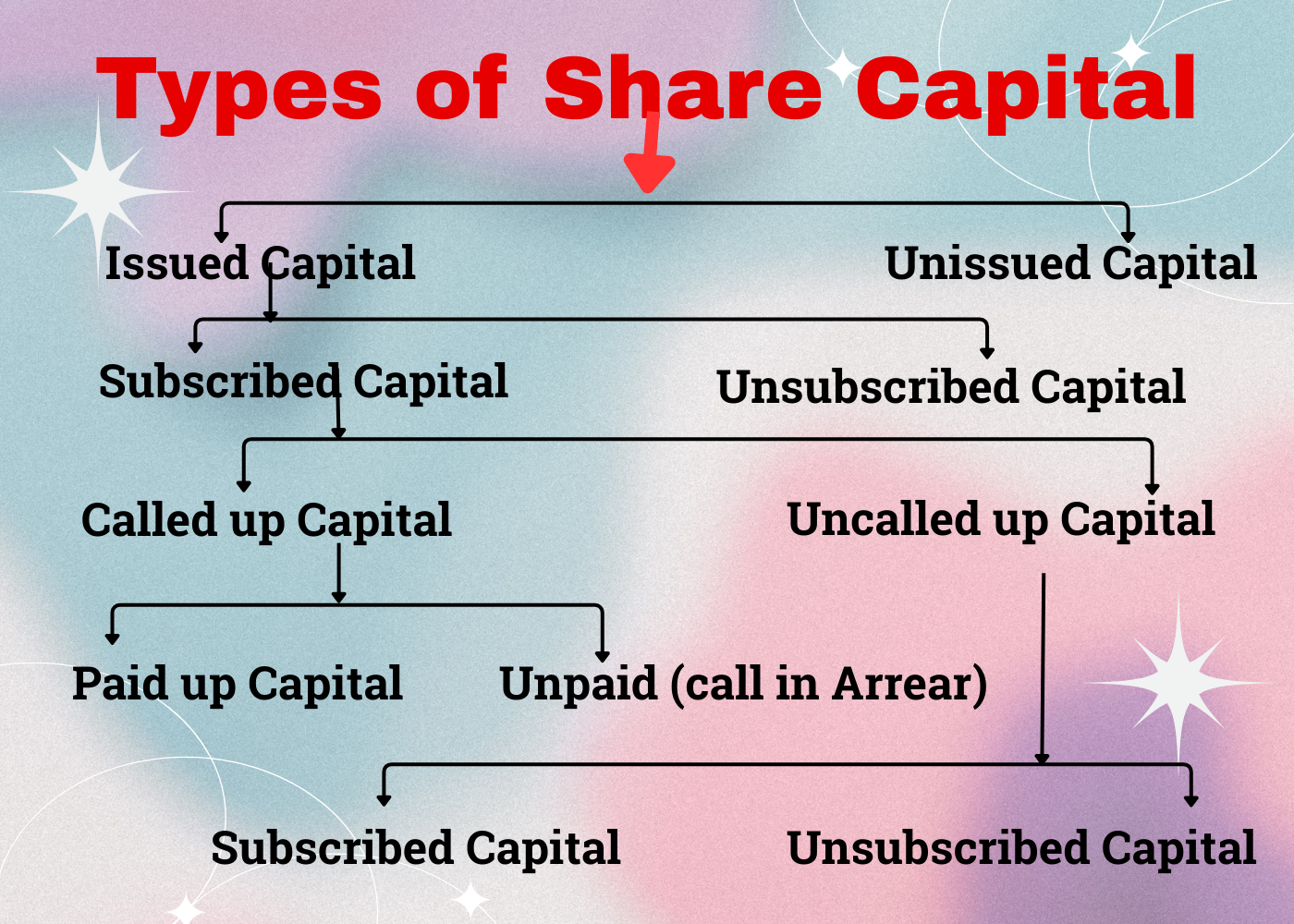
Types of Share Capital

Accountancy XII

Class 12,ย 

Accounting for Share Capital

A detailed flowchart titled "Types of Share Capital". It breaks down capital into Issued and Unissued, then further into Subscribed/Unsubscribed, Called up/Uncalled up, and finally Paid up/Unpaid (Calls in Arrear).

Share Capital

Meaning:

Share Capital is the amount of money a company raises by issuing shares to the public (shareholders). It represents the ownership money invested in the company by shareholders.

Share Capital = Funds raised by the company through shares (ownership money, not borrowed money like loans).

Explanation:

  • A company divides its total capital into small units called shares.
  • Each share has a face value (example: โ‚น10).
  • When people (investors) buy these shares, they become shareholders and contribute to the companyโ€™s capital.
  • This collected money is called Share Capital.

Example:

  • Suppose a company issues 1,00,000 shares of โ‚น10 each.
  • If all shares are bought by the public:
    1,00,000 ร— โ‚น10 = โ‚น10,00,000 (This is the Share Capital).

So, the company now has โ‚น10 lakh as Share Capital, contributed by shareholders.

Types of Share Capital

Figuring out share capital can feel like learning a new language. But it’s really just about tracking a company’s money at different stages. Let’s break it down from the top.

1. Authorised (or Nominal) Capital

Think of this as the company’s spending limit, set by its own rulebook. It’s the absolute maximum amount of money the company is legally permitted to raise by selling shares. They can’t issue shares beyond this cap without officially changing their documents.

  • In simple terms:The total value of shares the company isย allowedย to create.
  • Example:A company’s charter says it can create up to 100,000 shares, each with a face value of โ‚น10. That makes its authorised capital โ‚น1,000,000.

2. Issued Capital

The company doesn’t have to issue all its authorised shares at once. Issued capital is the chunk of that authorised limit they actually decide to offer to investors for purchase.

  • In simple terms:The value of shares the companyย actually offersย to sell.
  • Example:From its authorised pool of 100,000 shares, the company decides to launch an offer for 60,000 shares at โ‚น10 each. So, it has issued capital of โ‚น600,000.

3. Unissued Capital

This is just the leftover portion. It represents the remaining shares from the authorised limit that the company is holding back for now. They can issue these later when they need to raise more funds.

  • In simple terms:The value of shares the company hasย not yet offeredย to sell.
  • Example:With โ‚น1,000,000 authorised and โ‚น600,000 issued, the unissued capital is the remaining โ‚น400,000 (or 40,000 shares).

4. Subscribed Capital

Sometimes the public snaps up all the issued shares, sometimes they don’t. Subscribed capital is the portion of the issued shares that investors have actually agreed to buy.

  • In simple terms:The value of shares the publicย agrees to purchase.
  • Example:The company issued 60,000 shares, but investors only applied for 55,000 of them. The subscribed capital is therefore 55,000 shares x โ‚น10 = โ‚น550,000.

5. Unsubscribed Capital

This is the awkward gap. It’s the part of the issued share offering that investors passed on and didn’t buy. It represents capital the company hoped to raise but couldn’t.

  • In simple terms:The value of issued shares thatย nobody wanted to buy.
  • Example:With โ‚น600,000 issued but only โ‚น5,50,000 subscribed, the unsubscribed capital is โ‚น50,000 (5,000 shares).

6. Called-up Capital

A company doesn’t always ask for the full share price upfront. They might just ask for a portion of it now and the rest later. The called-up amount is the part of the share’s value they are formally requesting from shareholders.

  • In simple terms:The amount the companyย asks shareholders to payย right now.
  • Example:On the subscribed 55,000 shares (โ‚น10 each), the company might only “call” for โ‚น8 per share to be paid immediately. The called-up capital is 55,000 shares x โ‚น8 = โ‚น440,000.

7. Uncalled Capital

This is the flip side of called-up capital. It’s the portion of the money for subscribed shares that the company hasn’t asked for yet. It’s a promise of future payment that shareholders are liable for.

  • In simple terms:The amount the companyย hasn’t yet askedย shareholders to pay.
  • Example:If the full share price is โ‚น10 and only โ‚น8 has been called, the uncalled capital is โ‚น2 per share. For 55,000 shares, that’s โ‚น1,10,000.

8. Paid-up Capital

This is the real money in the bank. It’s the actual cash shareholders have paid so far against the company’s calls. This is the money the company truly has to work with.

  • In simple terms:The amount shareholdersย have actually paid.
  • Example:The company called for โ‚น400,000. Most shareholders paid in full, but a few were late, so the company actually received โ‚น380,000. That โ‚น380,000 is the paid-up capital.

9. Unpaid Capital (Calls in Arrears)

This is the outstanding bill. It’s the amount that has been called by the company but hasn’t been paid by the shareholders by the due date. It’s essentially money owed to the company.

  • In simple terms:The amountย shareholders oweย from a called payment.
  • Example:From the โ‚น400,000 called, the total paid was only โ‚น380,000. The missing โ‚น20,000 is the unpaid capital or “calls in arrears.”

10. Reserve Capital

This is a special safety net. It’s a portion of the uncalled capital that the company formally decides it can only demand in a worst-case scenarioโ€”specifically if the company is being shut down (wound up). It cannot be called during normal business.

  • In simple terms:Emergency funds that can only be called during liquidation.
  • Example:To protect future creditors, the company might resolve that โ‚น50,000 of its uncalled capital becomes reserve capital, ring-fenced for winding up.

11. Unreserved Capital

This is the company’s “ready-to-go” funding pool. It refers to any part of the authorised capital that hasn’t been earmarked, reserved, or issued yet. It’s the shares still sitting on the shelf, fully available for the company to issue to the public whenever they need to.

  • In simple terms:The shares stillย available for future issuance.
  • Example:With โ‚น1,000,000 authorised and โ‚น600,000 issued, the unreserved capital is the remaining โ‚น400,000. This is the capital not tied down by any prior commitment.

Conclusion

Share Capital is the lifeline of a companyโ€™s finances, representing the money raised from shareholders in exchange for ownership. By dividing capital into different categoriesโ€”like authorised, issued, subscribed, called-up, paid-up, and reserveโ€”the company can track its funds at every stage of the journey, from the maximum allowed to the actual cash in hand.

Understanding these types helps us see:

  • How much money a company can raise.
  • How much it has offered.
  • How much the public has invested.
  • How much the company actually holds.
Tags :
Accounting for companies, Authorised and Issued Capital, Called-up and Uncalled Capital, CBSE, Class 12 Accountancy notes, company accounts revision, Easy tips, ICSE, NIOS, paid up vs called up capital, Reserve Capital in Company Accounts, share capital, Shareholderโ€™s Equity, Subscribed vs Paid-up Capital, Types of share capital flowchart
Share This :

๐ŸŒŸ Admissions Open for Accounts, Economics and Business Studies for ๐‘๐ž๐ ๐ฎ๐ฅ๐š๐ซ (๐‚๐๐’๐„, ICSE, and IGCSE ) & ๐๐ˆ๐Ž๐’ ( National Institute of Open Schooling!) ๐ŸŽ“ Enroll Now for Crash Courses too! ๐Ÿš€ Secure your spot today! ๐Ÿ“š