
Unique Learning Academy
The Three Pillars of Economic Policy
16/05/2026
ECONOMICS- Class X
Class 10,
The Government and Macro Economics
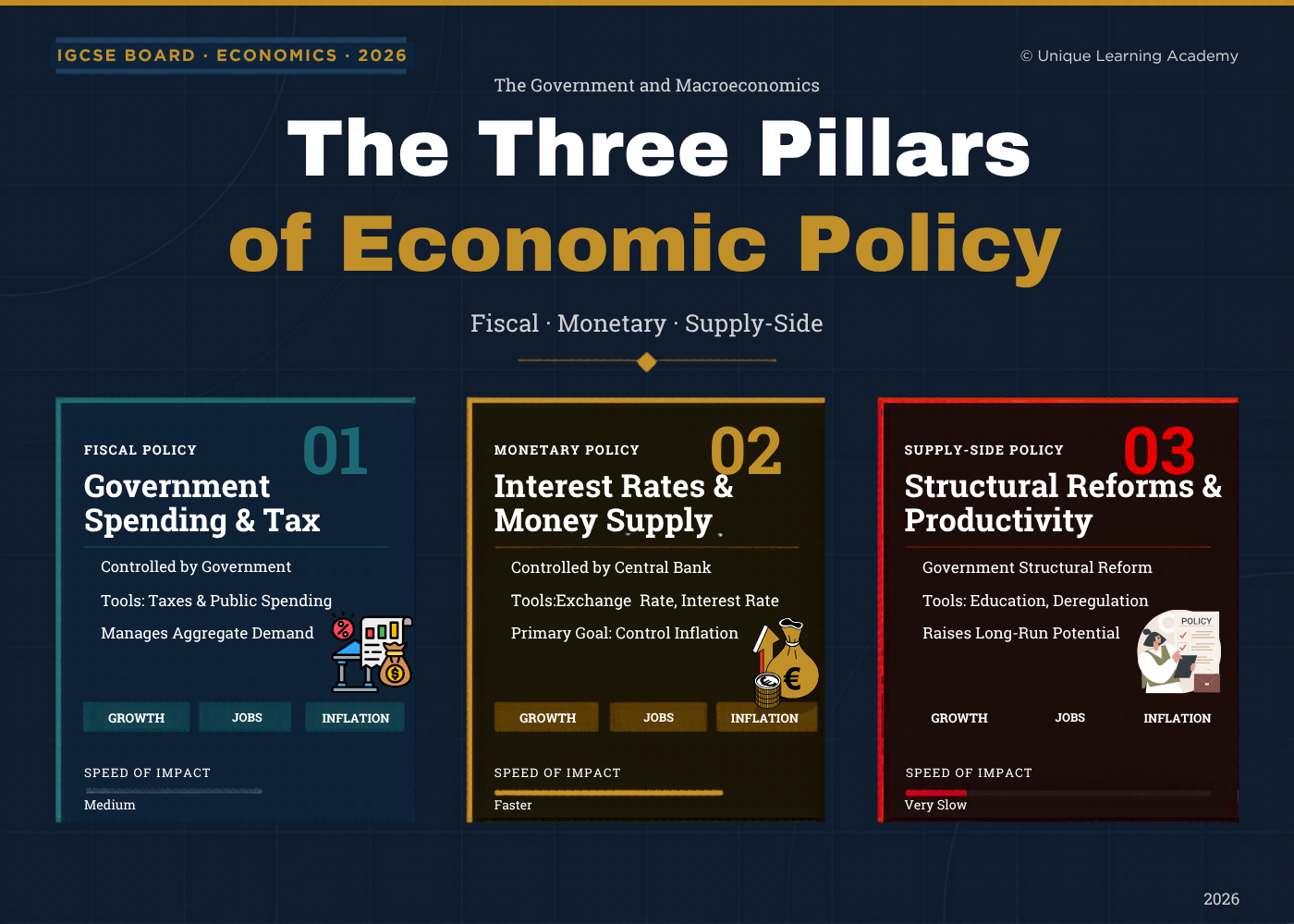
Fiscal, Monetary, and Supply-Side Policy — what they are, how they work, and why the difference matters.
When governments and central banks want to steer an economy — fighting inflation, reducing unemployment, or boosting growth — they reach for one of three toolkits. Understanding the difference between them is fundamental to reading the news, understanding politics, and making sense of the world.
Every country manages its economy through policies. Some work through the government’s budget; others through the banking system; and still others try to change the very structure of how an economy produces goods and services. These are, respectively, fiscal policy, monetary policy, and supply-side policy.
Though they often work together, they operate through completely different mechanisms, are controlled by different institutions, and act on different timescales. Let’s break each one down.
01 — FISCAL POLICY
Government Spending & Taxation
Fiscal policy refers to the government’s use of taxation and public spending to influence the economy. It is decided by elected governments — in India, that means the Union Budget presented by the Finance Minister; in the US, it is determined by Congress and the President.
Expansionary fiscal policy (more spending, lower taxes) boosts GDP in the short run through the multiplier effect — every rupee the government spends circulates through the economy multiple times.
Contractionary fiscal policy (raising taxes, cutting spending) reduces demand and is used to cool an overheating economy or reduce fiscal deficits.
Tools of Fiscal Policy
- Income tax cuts or increases
- Corporate tax adjustments
- Public infrastructure spending
- Social welfare transfers
- Defence & education budgets
- Government borrowing (deficit spending)
REAL-WORLD EXAMPLE
During the COVID-19 pandemic, governments worldwide deployed massive fiscal stimulus — direct cash transfers to citizens, wage subsidy schemes, and emergency public spending. India’s PMGKY relief package and the US’s CARES Act were both examples of expansionary fiscal policy.
The key limitation of fiscal policy is its time lag. Getting a budget through parliament, disbursing funds, and seeing economic effects can take months or even years. It is also inherently political, as spending and taxation decisions carry electoral consequences.
02 — MONETARY POLICY
Interest Rates & Money Supply
Monetary policy is managed not by the government, but by an independent central bank — the Reserve Bank of India (RBI), the US Federal Reserve, or the European Central Bank. Its primary lever is the interest rate, and its primary goal is to control inflation while supporting growth.
By raising or lowering the benchmark interest rate, the central bank makes borrowing more expensive or cheaper throughout the entire economy. Higher rates discourage spending and cool inflation; lower rates encourage borrowing, investment, and growth.
Tools of Monetary Policy
- Repo rate (key interest rate)
- Reserve requirements for banks
- Open market operations
- Quantitative easing (QE)
- Forward guidance
- Currency exchange management
REAL-WORLD EXAMPLE
In 2022-23, as inflation spiked globally, central banks went on an aggressive rate-hiking cycle. The US Fed raised rates from near zero to over 5%, while the RBI hiked the repo rate by 250 basis points in a single year — a textbook contractionary monetary policy response.
Monetary policy works faster than fiscal policy and is more politically insulated. However, it has limits — in a deep recession, cutting rates to zero (the ‘liquidity trap’) may not be enough to stimulate spending, no matter how cheap borrowing gets.
03 — SUPPLY-SIDE POLICY
Structural Reforms & Productivity
While fiscal and monetary policies manage demand in the economy, supply-side policy targets the productive capacity of the economy itself. It asks: how do we make our economy more efficient, innovative, and competitive in the long run?
Supply-side policies are structural reforms that improve the conditions under which businesses operate, workers are educated, and markets function. They are less about short-term stimulus and more about raising the economy’s long-run potential growth rate.
Tools of Supply-Side Policy
- Education & skills training
- Deregulation of industry
- Privatisation of state firms
- Trade liberalisation
- R&D and innovation support
- Labour market flexibility
- Infrastructure investment
- Reducing red tape & corruption
REAL-WORLD EXAMPLE
India’s GST reform (2017), which unified a fragmented tax system into a single national market, was a classic supply-side reform. China’s Special Economic Zones in the 1980s and the UK’s 1986 ‘Big Bang’ financial deregulation are other celebrated examples.
The great advantage of supply-side policy is its durability — reforms that improve education, infrastructure, and competition produce dividends for decades. The disadvantage is the same: results take years, sometimes a generation, to materialise, making them politically difficult to sell to voters who want immediate results.
“Fiscal policy is the sprint, monetary policy is the marathon, and supply-side policy is the training regime that makes both possible.”
Dimension | Fiscal Policy | Monetary Policy | Supply-Side Policy |
Controlled by | Government / Finance Ministry | Central Bank (RBI, Fed) | Government (structural reform) |
Main Tools | Taxes, public spending | Interest rates, money supply | Regulation, education, markets |
Primary Goal | Manage demand, employment | Control inflation, stability | Raise long-run growth potential |
Speed of Impact | Medium | Faster | Very Slow |
Affects | Aggregate Demand (AD) | Cost of borrowing / AD | Aggregate Supply (AS) |
Risk | Government debt, political bias | Deflation, liquidity traps | Short-term disruption, inequality |
Famous Advocates | John Maynard Keynes | Milton Friedman (Monetarism) | Reagan, Thatcher era economists |
How the Three Policies Work Together
In practice, a well-functioning economy uses all three levers simultaneously, and the right policy mix depends on the problem being solved.
Stagflation (high inflation + stagnant growth): Tight monetary policy can fight inflation but may worsen growth. Fiscal austerity risks deepening the recession. The only durable exit is supply-side reform — improving productivity and reducing cost pressures at their root.
Sharp recession: Monetary policy can lower borrowing costs quickly, while fiscal policy can directly inject spending into the economy. Supply-side reforms, while valuable, won’t help a person who is unemployed today.
The debate between these approaches is the central battleground of economic politics. Left-leaning governments tend to favour active fiscal policy and public investment. Right-leaning governments typically prefer monetary restraint and supply-side deregulation. In reality, the most successful economies have learned to use all three.
Impact on Economic Growth, Employment & Inflation
Each policy works differently on the three core targets that every government cares about: economic growth, employment/unemployment, and inflation. Every choice involves trade-offs.
01 — FISCAL POLICY — Government Spending & Taxation
ECONOMIC GROWTH Economic Growth
Expansionary fiscal policy boosts GDP in the short run through the multiplier effect — every rupee the government spends circulates through the economy multiple times. However, excessive deficit spending can crowd out private investment, potentially slowing long-run growth.
EMPLOYMENT Employment & Unemployment
Direct government spending on infrastructure, healthcare, and education creates jobs immediately. Tax cuts put money in consumers’ hands, stimulating private-sector hiring. Contractionary fiscal policy (austerity) does the opposite — public sector cuts can raise unemployment in the short term.
INFLATION Inflation
Expansionary fiscal policy adds to aggregate demand, which can be inflationary if the economy is near full capacity. Contractionary policy reduces demand and helps cool inflation. Governments must calibrate spending carefully — too much stimulus at the wrong time creates demand-pull inflation.
02 — MONETARY POLICY — Interest Rates & Money Supply
ECONOMIC GROWTH Economic Growth
Lower interest rates make borrowing cheaper for businesses and consumers, encouraging investment and spending — which accelerates GDP growth. Higher rates do the reverse. However, monetary policy has diminishing returns: when rates are already near zero, further cuts have little stimulative effect (the ‘liquidity trap’).
EMPLOYMENT Employment & Unemployment
The classic Phillips Curve relationship: lower interest rates stimulate the economy, raising business confidence and encouraging firms to hire. Unemployment tends to fall. Conversely, aggressive rate hikes slow the economy and can lead to layoffs — central banks explicitly accept some rise in unemployment to tame inflation.
INFLATION Inflation
This is monetary policy’s primary target. Higher interest rates reduce borrowing and spending, cooling demand and bringing prices down. Most central banks target around 2% inflation. The RBI’s Monetary Policy Committee has a formal mandate to keep CPI inflation between 2-6%. Rate hikes are the primary weapon against rising prices.
03 — SUPPLY-SIDE POLICY — Structural Reforms & Productivity
ECONOMIC GROWTH Economic Growth
Supply-side policies are the most powerful driver of long-run growth. By improving productivity, reducing costs of production, and encouraging innovation, they shift the economy’s potential output upward permanently. South Korea, Singapore, and China achieved sustained high growth rates largely through supply-side transformation.
EMPLOYMENT Employment & Unemployment
Supply-side reforms target structural unemployment — the mismatch between workers’ skills and employers’ needs. Better education and vocational training improve employability. However, short-term disruption from privatisation or deregulation can initially increase unemployment before long-run gains materialise.
INFLATION Inflation
Supply-side improvements are non-inflationary growth — the economy grows without overheating because productive capacity expands alongside demand. Increased competition from deregulation or trade openness reduces prices directly. Improved infrastructure lowers business costs, reducing cost-push inflation. This is why supply-side reform is the ‘holy grail’ — growth without the inflation penalty.
Impact Summary at a Glance
Outcome | Fiscal Policy | Monetary Policy | Supply-Side Policy |
↑ Economic Growth | Short-run boost via spending multiplier | Rate cuts stimulate investment | Long-run permanent rise in potential |
↓ Unemployment | Direct job creation via public projects | Lower rates encourage business hiring | Reduces structural unemployment via skills |
↓ Inflation | Austerity reduces demand-pull inflation | Rate hikes — primary inflation weapon | Raises supply, non-inflationary by nature |
Trade-off Risk | Spending can cause inflation if overdone | Rate hikes raise unemployment | Short-term disruption & inequality risk |
Best For | Recession / demand shortfall | Inflation control / credit conditions | Long-run competitiveness & productivity |
THE TAKEAWAY
Fiscal policy is the government pulling the levers of taxation and spending to manage demand. Monetary policy is the central bank adjusting interest rates to control inflation and liquidity. Supply-side policy is the long game — reforming the economy’s structure to make it more productive and competitive. Together, they form the complete toolkit of economic management. The next time you read about a budget, an interest rate decision, or a privatisation programme, you’ll know exactly which pillar of policy is at work — and what it’s trying to achieve.
Unique Learning Academy
Gurugram
Have Any Question?
Wish to enquire about our teaching pedagogy? Contact Us via Call or Email
- +91-9136-336-336
- contact@uniquelearning.in
Have Any Question?
Wish to enquire about our teaching pedagogy? Contact Us via Call or Email
- +91-9136-336-336
- contact@uniquelearning.in